When repair bills start to outrun the unit
Most owners wait until an air conditioner stops completely before asking whether it should be replaced. In practice, the better time to make that decision is earlier, when the repair pattern starts getting familiar. If you have paid for a regas, then a fan motor, then a drain repair, and now the compressor is weak, the unit is telling you something. It is not just one fault, it is age and wear adding up.
A good rule is simple: if the next repair will cost a large share of the price of a new unit, and the system has already had a few major parts changed, replacement deserves serious thought. That is especially true in Durban where units run hard for long stretches, often in humid air that speeds up corrosion on coils, terminals and drain pans.
Signs the system is reaching the end of its useful life
Some faults can be fixed once and forgotten. Others keep returning because the base machine has worn out. If your unit is showing several of these signs at the same time, it may be past the point where repairs make sense.
- Frequent breakdown call-outs, especially for different faults within a short period
- Weak cooling even after cleaning, gas checks and basic electrical repairs
- Compressor starting hard, tripping or drawing more power than before
- Rust on the outdoor unit, salt damage near the coast, or damaged fins and casing
- Persistent water leaks or drain blockages that return after clearing
- Loud rattling, bearing noise, or fan motor failures that keep coming back
- Old controls that no longer regulate temperature properly
If the unit is more than 10 to 12 years old, and especially if it has already needed compressor work, the discussion should shift from repair only to value over time.
The Durban conditions that wear units out faster
Air-conditioning around Clairwood, South Durban and the wider eThekwini area takes a beating. Coastal humidity means the system works harder to remove moisture, not just heat. Dust from workshop yards, loading areas and busy roads also builds up fast on filters and coils. In some buildings, power interruptions and voltage dips add extra strain on contactors, capacitors and control boards.
We also see older domestic systems in homes where the unit was installed for a smaller room, then expected to cool a larger space after renovations. It can run all day and still not reach the set temperature. When that happens the equipment is not failing in one dramatic way. It is simply undersized or worn out and costing more to keep alive than it should.
Repair now, replace later, or replace straight away
Not every fault means replacement. A blocked drain, a faulty capacitor, a failed contactor or a dirty coil is usually worth fixing. The real question is whether the repair restores reliable service for long enough to justify the spend. If the answer is yes, repair is the practical choice. If the answer is no, replacement starts making better financial sense.
At AIRCON DEPOT in Clairwood, we usually look at four things before advising a full change-out: the age of the unit, the cost of the current fault, the history of repeat work, and whether the replacement will improve running cost and comfort. For business owners, that includes checking whether downtime is affecting staff, stock or customers. For homeowners, it may simply be the difference between constant complaints and a room that actually cools properly.
- Low-cost fault with no repeat history: repair
- Major fault on an older unit: compare repair vs replacement
- Repeated compressor, gas or control issues: replacement may be better
- Unit too small for the room: replacement is usually the proper fix
What a replacement should improve, not just restart
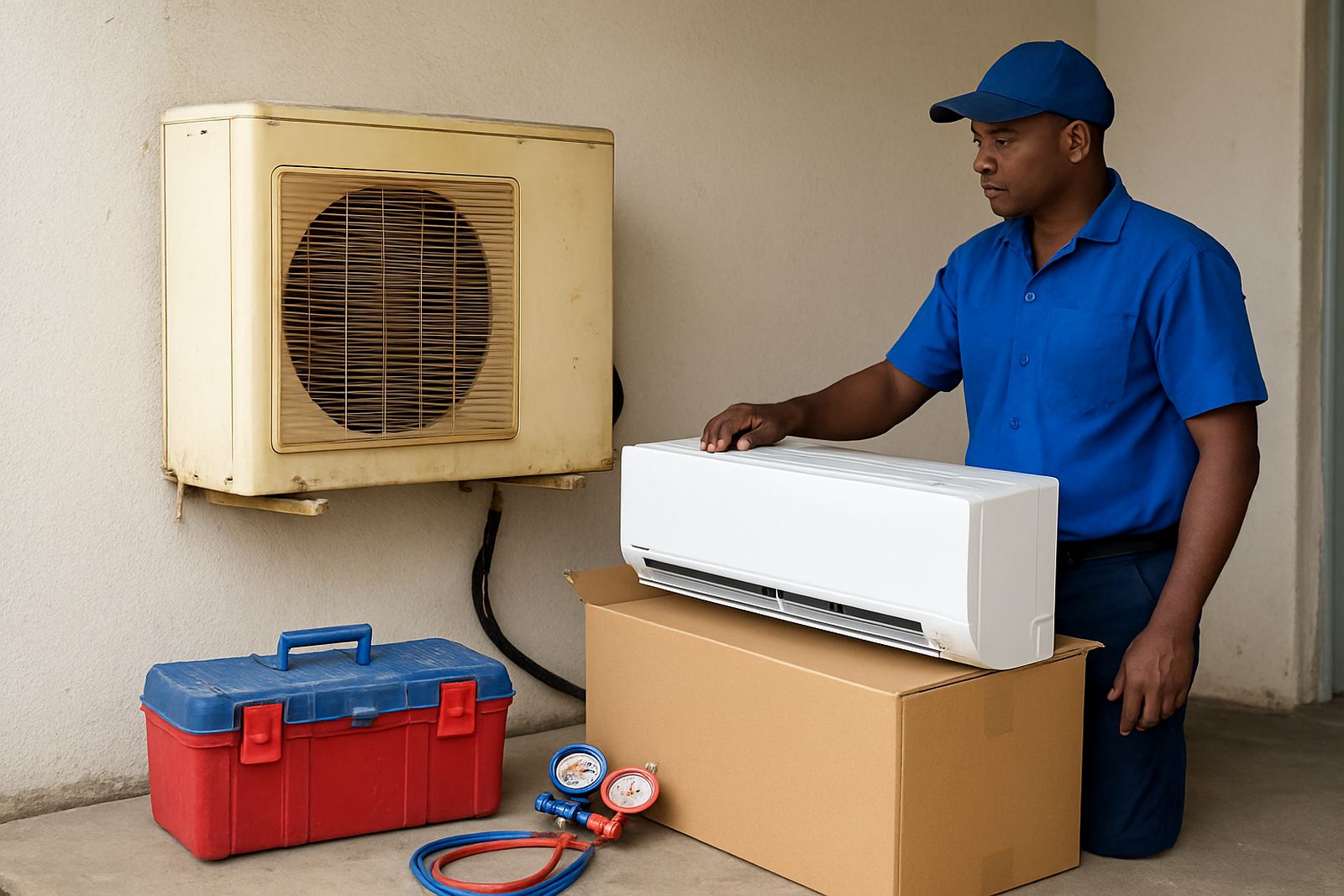
Replacing an old air conditioner should do more than give you cold air again. The new system should suit the room size, the running hours and the electrical supply on site. A correct replacement can reduce power use, shorten cool-down time and cut the number of service calls over the next few years. It should also be easier to maintain, with parts and gas support that are practical to source locally.
In many Durban properties, a replacement also gives the chance to fix old installation problems. That can include poor pipe routing, undersized cabling, bad drainage falls and units mounted where salty air hits them directly. A better installation often matters as much as the equipment itself.
A local example from South Durban
We recently worked on a small office near the industrial side of South Durban where the unit had been repaired several times over three years. First it needed a regas and leak check. Later the fan motor was replaced. After that, the compressor started tripping during peak afternoon heat. The owner wanted another repair because the office had to keep operating. Once we reviewed the history, the numbers told a different story. A new system, correctly sized and installed for the space, made more sense than spending again on a machine that had already reached its limit.
That kind of decision is common in eThekwini. People do not usually replace equipment for the sake of it. They replace when the pattern of faults, call-outs and power use shows the old unit is no longer paying its way.
A practical checklist before you decide
If you are unsure whether to keep repairing or move to a replacement, use a simple check before the next service visit. It helps you compare the short-term cost with the longer-term value.
- How old is the unit, and what has already been replaced?
- Have you had more than two major faults in the last 18 months?
- Is the room still cooling properly during the hottest part of the day?
- Has the outdoor unit rusted or corroded badly?
- Are you spending more on repeat call-outs than expected?
- Would a new unit improve comfort, power use and reliability?
If the answer to most of those points is yes, replacement is usually worth planning rather than delaying. A clear decision now can avoid one more summer of breakdowns, and the next repair may not be the last.