Why salon cooling works harder than office cooling
A salon is not a quiet office with steady numbers and low movement. People arrive in waves, dryers and straighteners run for long spells, and staff work close to clients for hours. That means the air-conditioning has to deal with heat build-up, moisture from washing and the constant opening of doors. In Durban, where the air can already feel sticky by mid-morning, the cooling system has to remove humidity too, not just lower the temperature.
Many salon owners think a unit that is fine in a small shop will also cope with a treatment room or a row of styling chairs. Often it does not. The result is uneven comfort, one corner that feels cold and another that stays warm, plus higher power use because the system keeps chasing a target it can never quite hold.
The rooms that need the most attention
Not every part of the salon needs the same solution. A reception area with a glass front needs different airflow to a back wash room or a nail station. Smaller enclosed rooms for facials, waxing or laser treatment can hold heat very quickly if the door stays shut. A waiting area near the entrance may also suffer from hot air coming in every time someone walks through.
- Reception and waiting areas need steady air movement without a cold blast on clients.
- Styling floors need faster cooling because dryers and people add heat at the same time.
- Private treatment rooms need quiet operation and good temperature control.
- Back rooms and stock areas still need ventilation, especially where chemicals or hot water are used.
In Clairwood and around Durban Central, we often see salons with a single unit trying to cover three different zones. That makes the system run longer and wear faster, and the back room still stays uncomfortable.
What coastal humidity changes in a beauty space
Durban humidity changes the way aircon feels. A room can be set to a decent temperature and still feel heavy if the moisture stays in the air. For salons this matters because staff are working all day in close contact with clients, and customers want to sit still without feeling clammy. Hair services, washing basins and warm products can add even more moisture to the space.
Good cooling in a coastal salon should help with dehumidifying as well as temperature control. If the system is undersized or poorly placed, the room may cool down on the display but still feel uncomfortable in practise. This is why a site visit matters. The right answer depends on floor area, ceiling height, glass frontage, occupancy, and how many heat-making tools are used at the same time.
- Check if the system is removing moisture properly, not only blowing cold air.
- Keep filters clean so airflow stays strong in humid weather.
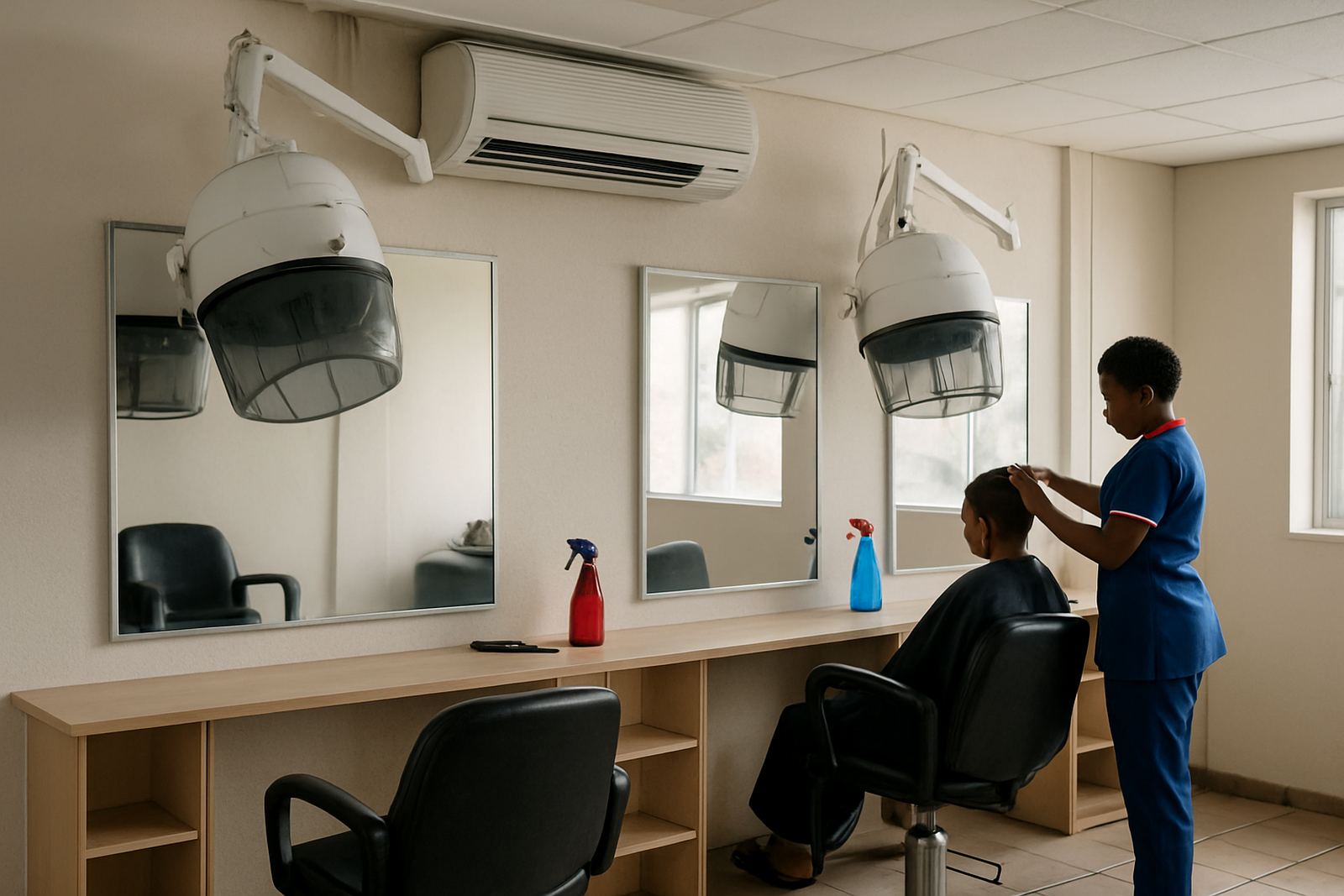
- Make sure wall units are not blocked by mirrors, shelves or styling stations.
Load-shedding and salon downtime
Power cuts can interrupt more than comfort. If a salon loses cooling during a busy afternoon, the room can become hot and stuffy quickly, and some products do not like repeated heat swings. Clients also notice when the space feels stale. A planned maintenance schedule helps reduce surprise failures, but the system also needs to be checked after each major outage because power dips can affect capacitors, contactors and controls.
During load-shedding, many salons in South Durban and West Durban try to restart every machine at once when power returns. That can place extra strain on the air-conditioning circuit and may trip protection if the system has already been working hard. A sensible restart plan, with timed switches and checked wiring, can save time and money.
Where business continuity matters, it is worth having a technician look at the condition of the compressor, fan motor and electrical parts before summer arrives. A unit that is limping along in autumn can fail completely on the first hot weekend of the season, which is never a good day for a salon.
Simple layout choices that make a big difference
Sometimes the cooling problem is not the machine alone, it is how the room is set up. Mirrors facing direct sunlight, blocked vents, or a unit blowing straight onto clients can all make the room feel wrong even if the temperature reading looks fine. A salon should feel even, calm and draught-free so clients can relax while staff work without sweating.
Practical changes are often small and affordable. Moving a station a metre or two, adding a blind to a hot window, or changing the angle of the unit can improve comfort without major building work. In some cases a second unit in the right place works better than forcing one system to do everything. That also helps during busy Saturdays when chairs are full and hair dryers are running non-stop.
- Keep doors closing properly so cooled air does not escape into the passage.
- Avoid placing heat tools directly under the air outlet.
- Clean condenser and indoor coils regularly in dusty urban areas.
- Check drainage so condensate does not drip onto floors or retail shelves.
When a fault starts as discomfort
Salon owners often notice an aircon problem before a complete breakdown. The room feels warmer than usual, one treatment room takes longer to cool, or the unit starts making noises after lunch. These small signs often point to blocked drains, low gas, dirty filters, a weak fan motor or a control fault. If the system is left too long, the compressor can begin working harder and power use climbs as well.
For a busy beauty space, fast fault finding matters. A same-day call-out can prevent a ruined appointment book, and a leak check or regas should always go with a proper inspection rather than a quick top-up. If the unit has repeated issues, it may need parts replacement instead of more short-term fixes. That is especially true in older salons where equipment has been patched over the years and no one has checked the full system for a while.
A Durban example that shows the real pattern
Take a salon in Clairwood with three styling chairs, a wash basin area and a small treatment room at the back. On paper, the place looks modest. In reality, six or seven people may be inside at once, dryers run in bursts through the morning, and the front door opens to a warm corridor every few minutes. On a humid Durban day the indoor temperature rises much faster than the owner expects.
After a proper site check, the fix was not one big guess. The team looked at room size, airflow, usage times and the hot glass front. One indoor unit was serviced, another needed a drain blockage cleared, and the treatment room got a better cooling pattern. The result was not fancy, just comfortable and dependable. That is what matters in a salon where customers sit still and notice every small change in air quality.
For beauty spaces in Clairwood, Durban Central and across greater eThekwini, the right air-conditioning plan is not about overdoing it. It is about matching the cooling to the people, the tools and the weather, so the room stays pleasant from the first booking to closing time.