Why the condenser’s location matters from day one
The outdoor unit is the part that throws heat out of the building, so it needs open air around it. If it is boxed into a tight corner, pressed against a wall or hidden behind clutter, the system has to work harder. That usually shows up as higher electricity use, warmer rooms, nuisance noise and more call-outs for faults that could have been avoided.
For homes and shops in Clairwood and across Durban, placement is not only about cooling. It is also about keeping the unit reachable for cleaning, checking gas lines and replacing parts when needed. A condenser that is easy to get to can be serviced properly. One that sits over a roof edge, behind dense shrubs or under a low beam becomes awkward fast, and awkward often means neglected.
- Leave enough breathing space around the unit for airflow.
- Keep the area clear for technicians to reach panels and pipework.
- Choose a spot that limits noise transfer into bedrooms or customer areas.
- Allow space for future repairs, not just the first installation.
Airflow clearance and shade without choking the unit
An outdoor unit needs fresh air moving across the coil and out again. When air recirculates, cooling suffers. That is why simple rules matter: do not trap the unit in a narrow alley, against a boundary wall with no escape path, or in a sealed cabinet with tiny louvres. Shade can help reduce direct sun load, but shade must never block airflow.
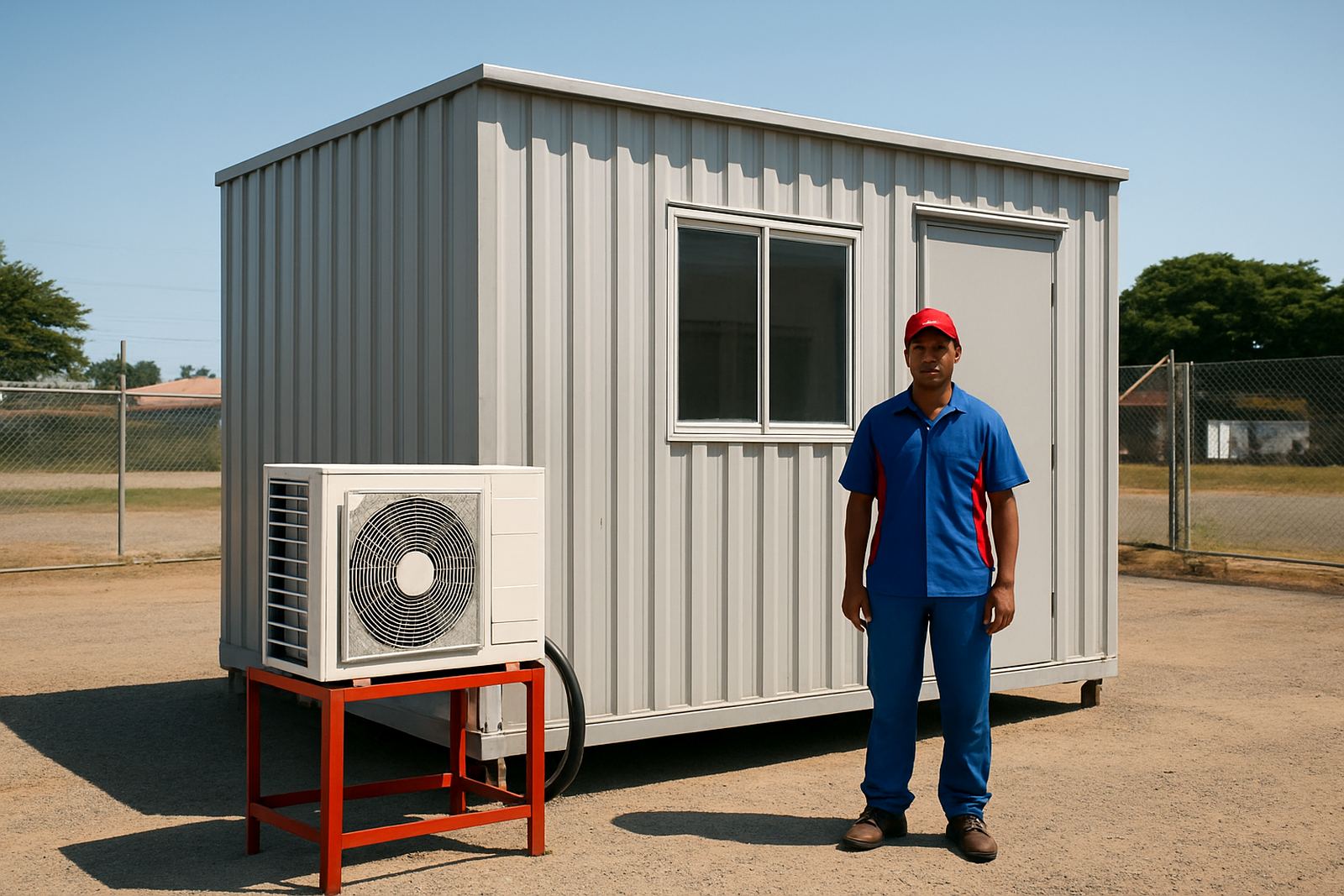
In Durban’s coastal belt, people sometimes place units where they are hidden from view but then the air intake becomes restricted. A better option is a raised frame or a wall mount with proper clearances, set where the sun is reduced by an overhang or screen yet the sides stay open. The unit should also sit above splash height in areas that get heavy rain or wash-down water.
- Keep the top and sides open as per manufacturer guidance.
- Avoid placing the unit where hot exhaust air from another machine blows back onto it.
- Use shade structures that do not block service panels or fan discharge.
- In coastal areas, allow for salt spray and easy rinsing during maintenance.
Good airflow is not a luxury. It is part of the system’s basic health.
Noise, neighbours and where the sound travels
Outdoor units make a steady fan sound and a low compressor hum. That is normal, but poor placement can make the sound travel further than it should. A unit fixed to a light wall can rattle. A unit placed in a courtyard can bounce sound between surfaces. At night, that can be enough to annoy neighbours or disturb staff in a nearby room.
When we look at a site, we think about what sits on the other side of the wall, fence or passage. In a small flat, the outdoor unit should not sit just outside a bedroom window if there is another option. In a shop or office, it should be kept away from customer seating, cashier points and any area where people gather for long periods. Simple anti-vibration mounts and a solid base help, but the position still matters most.
- Place the unit away from bedrooms where possible.
- Avoid corners that bounce sound into neighbouring properties.
- Use a firm base so the compressor does not shake the structure.
- Check that service access does not force the unit into a noisy, cramped recess.
Service access is what keeps repairs affordable
Many aircon faults become expensive because the outdoor unit is hard to reach. If a technician cannot get proper access to the fan motor, electrical compartment, isolator or pipe connections, even a simple job takes longer. That adds labour time and can mean more risk to the unit and the building.
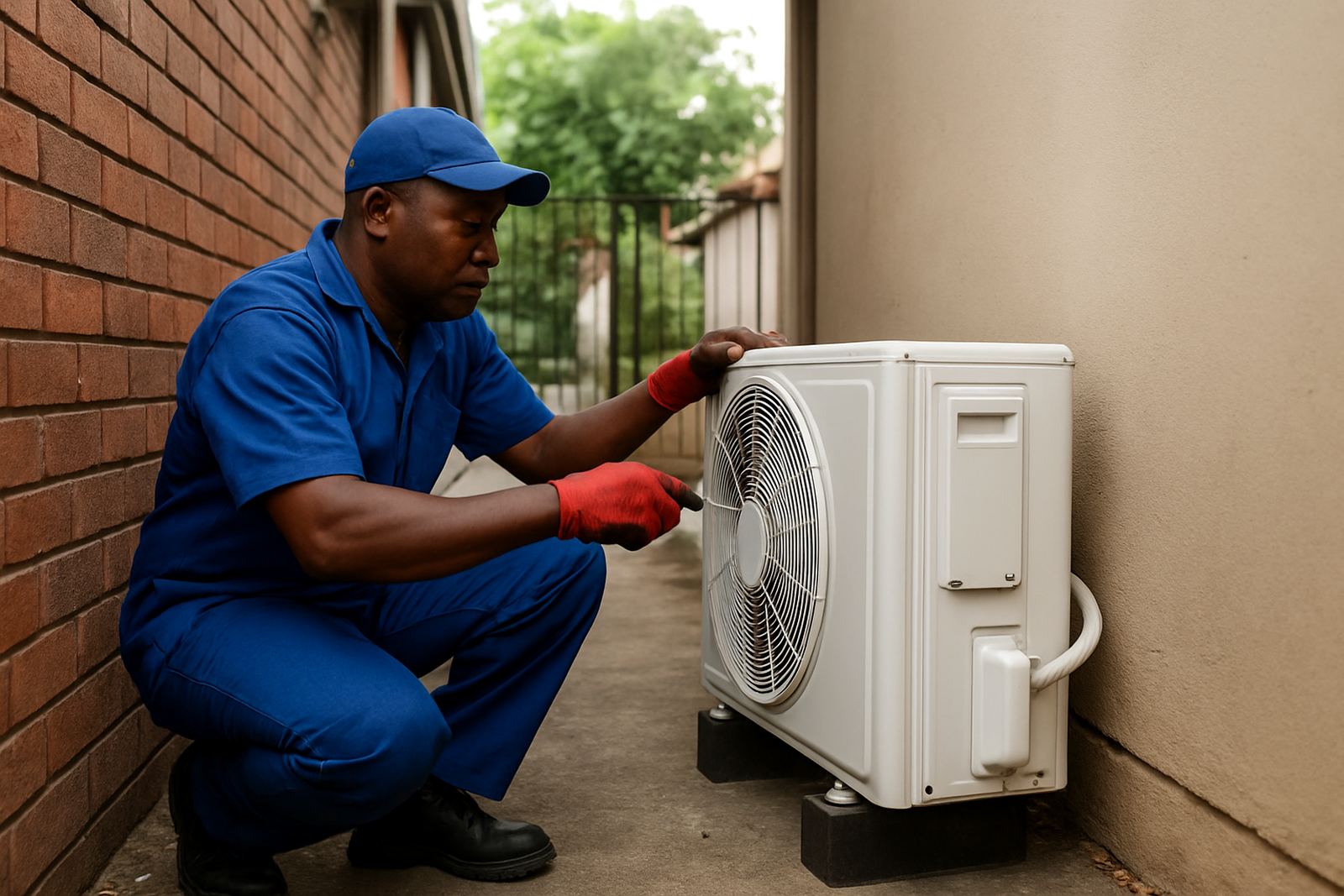
Good placement means a technician can open panels fully, remove covers, test capacitors and contactors, clean the coil and check for leaks without standing on unsafe ladders or moving other equipment out of the way. It also makes routine maintenance faster. A unit that is easy to service is more likely to be serviced on time, and that extends the life of the system.
At Aircon Depot, we see this often in older Durban properties where the original install was done with little thought for later access. A small adjustment at installation time can save a lot of Rand over the years.
- Do not box the unit in so tightly that side panels cannot open.
- Leave room for tools, test equipment and cleaning access.
- Keep the base stable and level so drainage and vibration stay under control.
- Make sure the isolator and pipework are reachable without unsafe stretching.
Durban conditions: salt air, rain and load-shedding realities
Durban’s weather asks more of outdoor units than many inland areas. Salt in the air can speed up corrosion, especially if the unit is too close to the shoreline or left exposed with no maintenance. Heavy rain can push debris into the coil. During load-shedding, units stop and start more often than people expect, so any weak electrical connection or poor installation detail gets exposed.
For that reason, the safest position is often one that is slightly elevated, protected from direct spray, and not sitting where garden runoff or flood water can collect. In homes and small businesses, it is also sensible to keep the unit away from washing lines, bins and cooking areas where grease or lint can clog the coil. A little care at placement stage reduces the need for deep cleans and emergency breakdown call-outs later.
If a property is near the coast or in a windy area such as parts of South Durban, the installer should think about corrosion, cable routes and how the unit will be anchored. Loose brackets and poor wall fixings are not worth the risk. The unit must be secure before the first summer storm arrives.
A local example from Clairwood to the CBD
We recently looked at a small commercial property in Clairwood where the outdoor unit had been mounted in a narrow service yard between two walls. The system was cooling slowly and the owner thought the gas level was the problem. In reality, the condenser was recirculating hot air because there was barely any clearance behind it and the fan was pulling in warm air from the same space.
Once the unit was repositioned to a better ventilated spot with proper access, the running temperature dropped, the room cooled quicker and the repeated trips on overload stopped. The owner also saved time because future maintenance could be done without shifting stock or climbing awkwardly around pipes. It was a small change, but it made daily use far more practical.
- Better position can fix performance issues without replacing the whole system.
- Clear access helps with planned maintenance and breakdown response.
- Good placement can reduce noise complaints from staff and neighbours.
That is the kind of practical job that makes sense for homes, shops and workshops across Durban Central, North Durban, West Durban and the wider eThekwini area.
When to ask for a placement check before the next install
If you are planning a new installation, replacing an old unit or moving equipment during renovations, ask for a placement check before the mounting work starts. It is the right time to sort out airflow, drainage, pipe runs, wall strength and access. It is much easier to change a bracket location before holes are drilled and copper is bent.
Aircon Depot handles domestic and commercial air-conditioning work from Clairwood across greater eThekwini, including fault finding, regas and leak checks, compressor replacement, fan motor repair, controls repair and breakdown call-outs. If your outdoor unit is noisy, hard to reach or sitting in a poor position, we can assess whether a change will improve performance and make servicing easier.
For advice or a site check, contact depot@aircondepot.co.za. A good condenser position does not need to be complicated, but it does need to be thought through properly.