Why drain fall matters more than most people think
Every split system makes water. As warm room air passes over a cold indoor coil, moisture condenses and must run away through the drain line. If that line has the correct fall, water moves out on its own. If it sits flat, lifts up, or dips in the wrong place, the water slows down and starts backing up into the unit or out onto the wall. That is where many leak complaints begin.
In Durban and the wider eThekwini area, humidity makes this worse because units pull more moisture from the air. A drain line that seems acceptable in winter can give trouble as soon as the wet weather comes back. We often see systems in Clairwood, Durban Central and South Durban where the aircon itself is fine, but the drainage was never set correctly from day one.
The key point is simple: the drain must move water away by gravity. It does not need to be dramatic, but it does need a steady fall. A line that is neat to the eye is not always correct to the level. That is why proper installation and testing matter, not just a quick fit and go.
What correct slope looks like on site
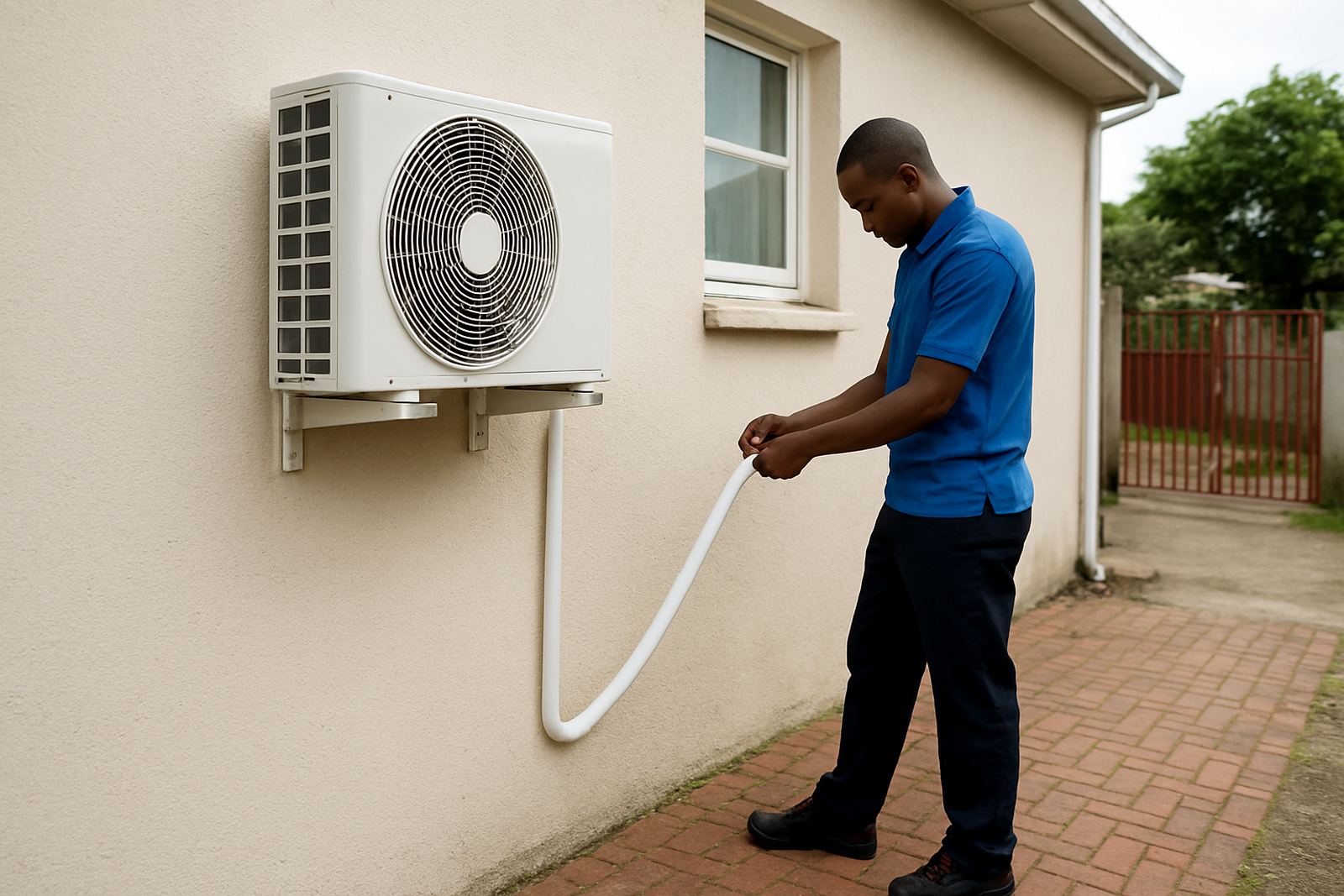
Drain fall is the angle of the pipe that carries condensate from the indoor unit to the outside point or drain. In practical terms, the line should drop gently and continuously without rising sections or low pockets where water can sit. Even a small upward hump can trap sludge, dust and algae.
On a normal split installation, the technician should check the route before drilling and running pipework. The indoor unit must sit level or with the correct slight tilt as specified by the manufacturer, then the drain hose should run on a steady fall all the way to discharge. If the route is too long, the wall bracket or ceiling space may need adjusting. Sometimes the problem is not the unit, its the pipe path chosen during installation.
In commercial spaces around West Durban and North Durban, you also get longer runs, more bends and sometimes a connection into a shared drain. That can work well, but only if the route is planned properly and tested with water before the job is signed off.
- Look for a continuous fall, not a series of dips and rises.
- Keep the hose clipped so it cannot sag over time.
- Make sure the outlet is clear and not pushed into standing water.
- Allow for vibration so joints do not pull apart.
Signs the drain line is causing the leak
Many customers think a leak means gas trouble, but water complaints often point to the drain first. If the unit cools normally and then starts dripping after a while, that is a strong clue. If there is a musty smell, marks on the wall, or water running inside after heavy use, the drain path should be checked before anything else.
A blocked filter can add to the problem because dirt drops into the drain pan and line. So can a dirty coil. But if the unit has been cleaned and the leak still returns, poor fall is often the real issue. We have seen systems in flatlets, shops and offices where the pan was clear, the pump was working, yet the water still came back because the pipe was almost level for three metres.
Watch for these warning signs:
- Water dripping from the indoor unit during normal operation
- Stains on the wall below a split unit
- Gurgling sounds from the drain line
- Water leaking only on very humid days
- Repeated call-outs for the same fault after previous repairs
If the same complaint keeps coming back, the installation should be reviewed as a whole, not just patched at the end. That is where proper fault finding saves time and money.
A real Durban example from a ground-floor office
We recently attended a ground-floor office in Clairwood where a split unit above a storage area kept leaking onto cartons. The first assumption was a cracked tray, then a blocked drain, then a failed pump. The tray was sound, the drain was open and the pump tested fine. The actual fault was drain fall. The line ran behind a bulkhead, rose slightly near a joint and then flattened out before dropping to the outside point.
Because the line held water in the high spot, dirt settled there and created a soft blockage. Every time the unit worked hard in the afternoon heat, the pan overflowed. Once the pipe route was corrected and re-clipped with a proper continuous fall, the leaking stopped. That job could have been avoided with better planning at install stage, but it is a common issue in older commercial buildings where alterations have been made over time.
In coastal Durban, small faults like this show up faster because moisture is constant and mould builds quickly. A ceiling stain may start as a tiny mark and become a proper repair if the drainage issue is left to drag on. It is cheaper to sort the slope early than to keep repainting and replacing damaged ceiling board.
How technicians check drain fall properly
Checking drain fall is more than just looking at the pipe. A good technician will trace the full route, check for sagging, inspect joints, and test the line with water. They will also look at the unit installation level, the tray condition, insulation around the pipe, and the outside discharge point. If a pump is fitted, the pump operation and switch need to be confirmed too.
At Aircon Depot, we look at the full cause, not only the symptom. A leak can come from poor fall, but it may also be made worse by a dirty coil, loose connection, damaged insulation or a drain line that was never secured properly. We work on domestic and commercial systems across Clairwood, Durban Central, South Durban, North Durban, West Durban and the greater eThekwini area, so we see these patterns often.
- Measure the route and identify flat sections
- Test flow with clean water, then check for slow return
- Inspect for algae, dirt build-up and crushed pipe
- Confirm the discharge point is open and not blocked by debris
- Check that service access is still available for future maintenance
How to prevent repeat water leaks after an install
The best time to fix drain fall is during installation, before the pipework is covered. Once ceilings are closed or bulkheads are built, a simple slope problem becomes a bigger job. If you are replacing an old unit or adding a new one, ask how the drain will run, where it will discharge, and how it will be tested. That one conversation can save a lot of grief later.
Planned maintenance also helps. During a service, the drain line should be cleared, the coil cleaned and the unit checked for early signs of overflow. In load-shedding periods, when systems stop and start more often, dust and moisture can sit longer in the tray which makes blockages more likely. In some cases, a drain that has been fine for years suddenly starts causing trouble because the system is now running under different conditions.
For property owners, the practical takeaway is this: do not accept repeated leaking as normal. A split unit should carry water away quietly and without fuss. If it does not, there is usually a reason that can be found and fixed properly.