Start with the fault, not the fear
People often ask if a noisy, weak or leaking aircon is still worth repairing. The short answer is that the fault type matters more than the panic it causes. A tripped breaker, blocked drain, dirty filter or failed capacitor is usually a repair job, not a reason to scrap the whole system.
What changes the picture is whether the fault has spread. A unit that is icing up because of low gas may only need a leak check, regas and proper sealing. But if it has been running like that for months, the compressor and controls may have taken a knock. In that case the repair still may help, but only if the rest of the unit is sound.
Good fault finding saves money because it separates a small electrical issue from a bigger mechanical problem. That is the first test before anyone talks about replacement.
Age matters, but it is not the whole story
An aircon with ten good years behind it can still be worth repairing if it has been serviced, kept clean and installed correctly. On the other hand, a newer unit in poor conditon may be a worse bet than an older one that has been maintained. Age tells you how much wear to expect, not the final answer.
As a practical guide, look at three things:
- How often it breaks down in a season
- Whether parts are still available without long delays
- Whether the unit still cools the room without running flat out all day
If the aircon is older but the case, coil, wiring and fan motor are still healthy, a targeted repair can be cheaper than replacing the whole setup. If the unit has repeated compressor trouble, burnt controls, or major corrosion inside the casing, the repair bill can start to fight against common sense.
When the part is small, repair usually wins
Some faults are simply not replacement faults. A failed capacitor, contactor, fan motor, drain blockage or control issue is often a straightforward repair. These are the parts that usually give warning signs first, such as humming, slow starts, water dripping indoors or a unit that switches on and off too quickly.
Repairs also make more sense when the fault is localised. If the outdoor fan still turns freely, the compressor draws correct current, and the coil is in decent shape, there is no reason to throw out the whole machine because of one failed component. In many Durban homes and shops, that kind of repair can get the aircon back to normal the same day.
- Electrical faults can often be fixed with parts testing and replacement
- Drain and airflow issues are usually cheaper than major mechanical work
- Routine cleaning can stop a small fault from becoming an expensive one
This is also where planned maintenance helps. A quick service before summer, plus a check after heavy rain or power cuts, can catch wear before it becomes a breakdown call-out.
Efficiency is where repairs pay for themselves
People sometimes think repair is only about getting the unit back on. It is also about how much electricity the aircon is using to do the same job. A dirty coil, low gas charge, blocked drain or faulty sensor can push the system to run longer and harder. That means higher power use and less comfort.
If a repair restores proper cooling and shortens run time, it can save money every month. This matters in South Durban, where many homes and small businesses rely on their units through hot afternoons and humid nights. It also matters during load-shedding, because when power returns, the aircon should restart cleanly rather than struggling through a weak start.
Repair helps most when it brings the unit back to its original working conditon. If the system can still reach the set temperature without constant cycling, strange smells or noisy operation, the fix is usually worthwhile.
Durban conditions change the repair equation
Coastal humidity and salt in the air are hard on metal parts, electrical connections and outdoor units. In places like Clairwood and the wider eThekwini area, we see more drain blockages, corrosion around terminals and fan problems than people expect. A unit that would survive inland can wear faster near the coast if it is not cleaned and checked often.
That is why local experience matters. A repair decision in Durban should take into account the environment, the building use and the amount of daily running time. An office unit in Durban Central that runs all day has a different life from a bedroom unit used only at night. The same fault may be a simple fix in one case and a sign of heavier wear in another.
Municipal and building rules can matter too, especially for commercial properties where access, noise and outdoor unit placement need to stay in line with site requirements. A proper repair plan keeps the equipment working and avoids repeat call-outs caused by poor installation or blocked airflow.
When replacement starts to make more sense
There are times when repair is still possible, but not wise. If the compressor is failing on an older machine, if corrosion has spread through the casing and coils, or if the same fault keeps coming back after previous work, the unit may be reaching the end of its useful life. A repair can buy time, but it should buy useful time, not just one more month of trouble.
A replacement conversation becomes fair when:
- The repair cost is close to the value of the unit
- Parts are scarce or likely to delay the job for too long
- The aircon no longer cools the space properly even after service
- There have been repeated leaks, compressor issues or electrical failures
For shops, clinics and offices, downtime is part of the calculation too. If a breakdown keeps staff, stock or customers uncomfortable, the faster option may save more than the repair itself.
A Clairwood example: fix the fault before the season breaks it
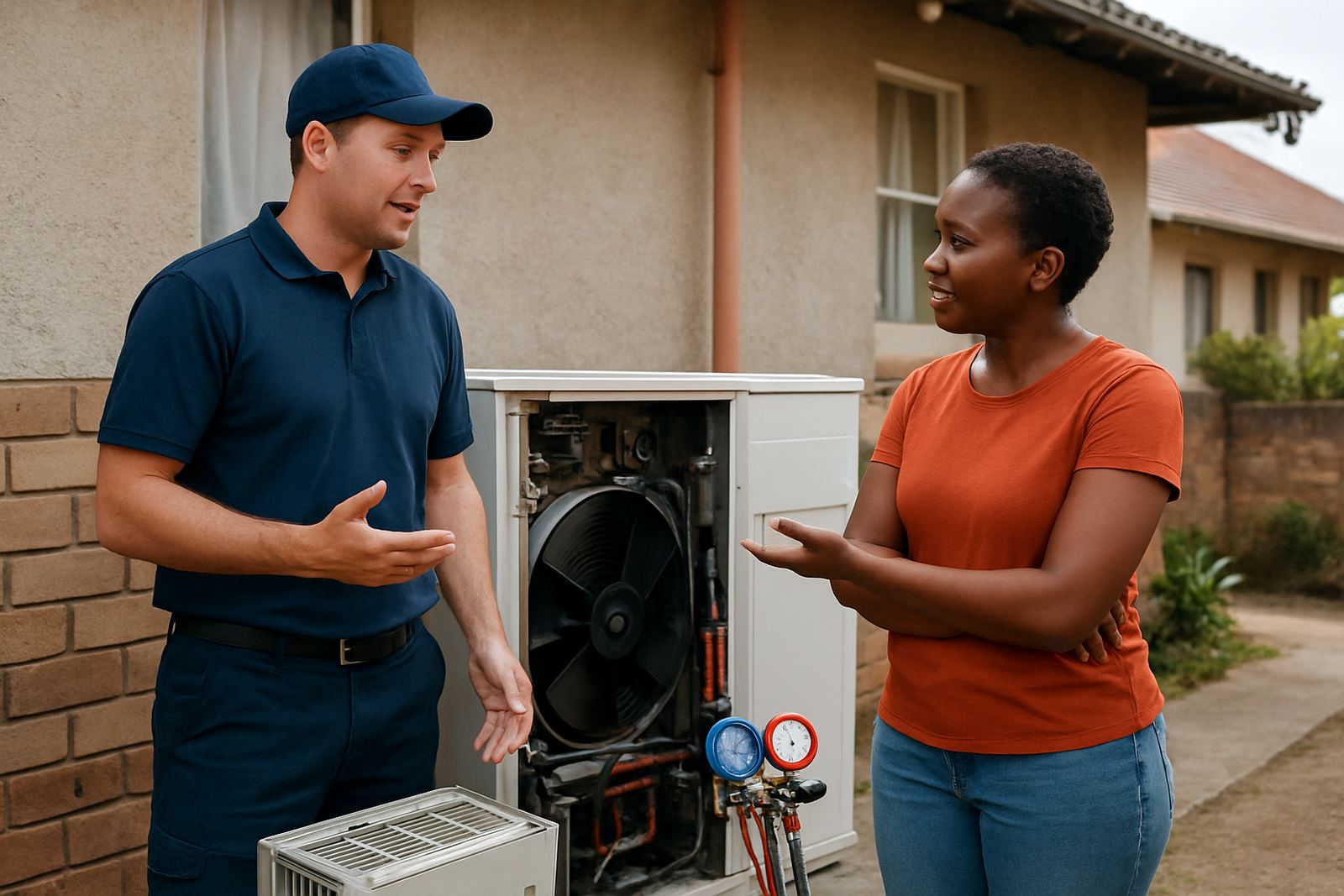
We recently looked at a domestic unit in Clairwood that was blowing warm air after each power outage. The owner thought the compressor was finished, but the real problem was a weak capacitor, a dirty indoor coil and a partially blocked drain. Once the parts were tested and replaced, the system cooled properly again and the next electric outage did not leave it stuck.
That is the kind of case where repair helps clearly. The unit was not old enough to justify replacing, the fault was specific, and the rest of the system was still in fair shape. A clean service and proper check saved the client from buying a whole new unit and the room was back to normal that afternoon.
For many Durban households and businesses, that is the better path: diagnose carefully, repair what can be fixed, and only replace when the numbers and the condition say so.