Why guesthouse aircon needs to work harder than you think
A guesthouse is not a house with a few extra rooms. It runs like a small hospitality business, which means each room, passage and common area needs to feel right at different times of day. In Durban, that comfort also has to hold up in hot, humid weather, salty coastal air and the occasional load-shedding interruption. If one room is too warm or noisy, the complaint is usually immediate and the cost is not only in power, it is in ratings and repeat stays.
For guesthouses in Clairwood, South Durban, Durban Central and the wider metro, the best setup is usually one that gives the owner control room by room and keeps maintenance simple. That means sensible unit selection, neat routing of pipes and drains, and equipment placed where staff can reach filters and isolate faults without disturbing guests. We often find that the issue is not the aircon itself, but poor planning around airflow, drainage or electrical supply.
Typical equipment for rooms, lounges and reception spaces
Most guesthouses use a mix of wall-mounted split units for bedrooms and larger units for lounges, breakfast rooms and reception areas. Smaller rooms often need compact 9 000 to 12 000 BTU units, while larger bedrooms or family rooms may need 18 000 BTU or more depending on sun exposure, ceiling height and insulation. Common areas can need a bigger system, but it is still better to divide the load where practical so one failure does not take down the whole building.
In coastal Durban, we also factor in corrosion resistance, regular filter cleaning and proper condensate drainage. Units installed too close to the sea breeze or with poor support tend to age faster. A practical guesthouse package usually includes the following:
- Room-by-room split units for sleeping areas
- A larger unit or two for reception and dining areas
- Proper pipe insulation and tidy trunking
- Safe condensate drain routing to prevent dripping and damp patches
- Isolators and electrical protection for easier servicing
Layout and planning advice for occupied guest properties
Planning matters because a guesthouse cannot easily shut down for long. We usually start by mapping the building use, guest flow and available electrical capacity. Bedrooms on the sunny side of the property often need more cooling, while shaded rooms can sometimes use smaller units. If a property has a reception area, breakfast room and corridors that stay busy, those spaces should be treated separately from the rooms so guests do not compete for one system.
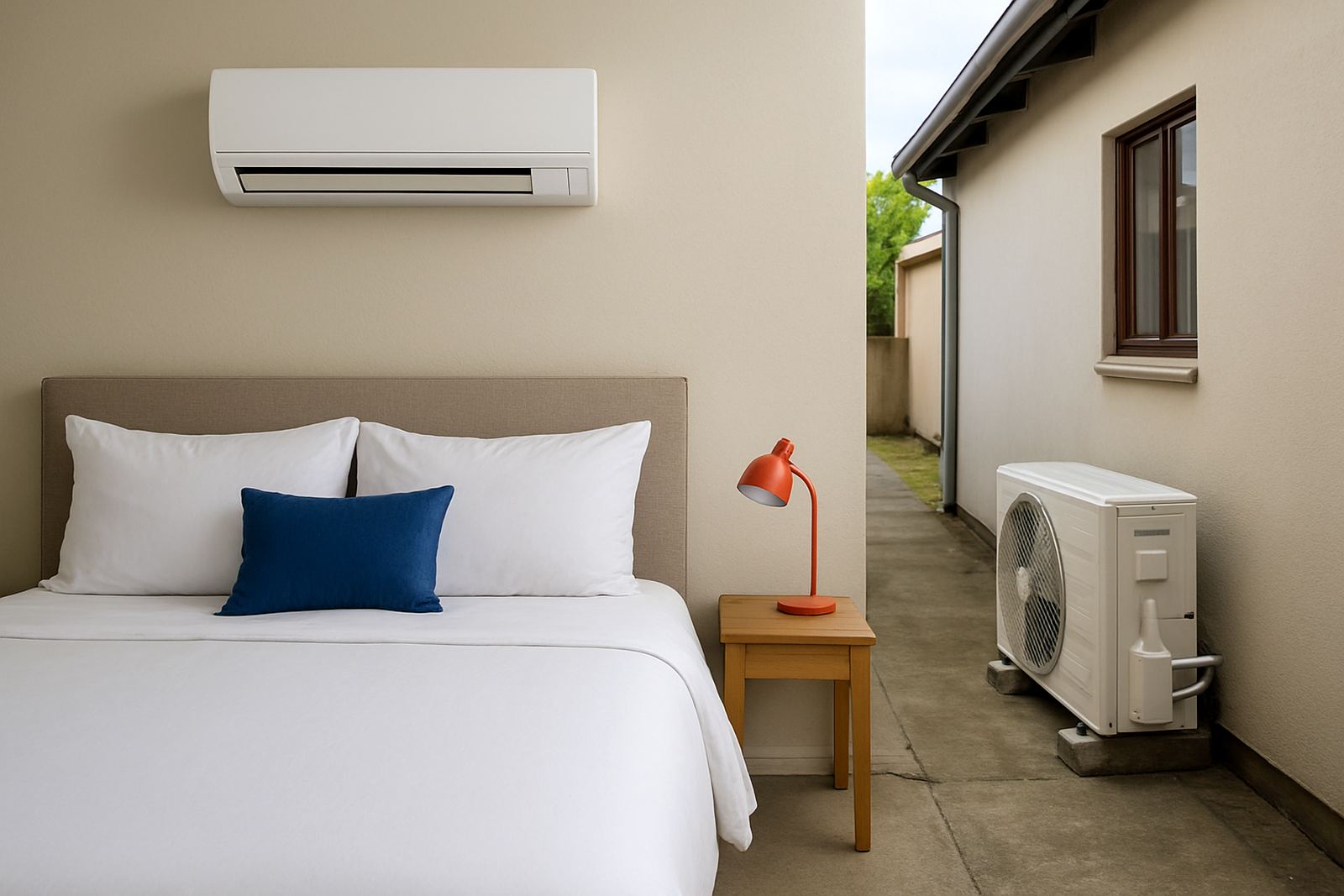
We also look at where condensate water will go. A blocked drain that leaks onto a passage floor or down a wall causes more damage than many owners expect. In older buildings, the route for refrigerant piping and drainage may need careful planning to avoid ugly runs and future access problems. It also helps to position outdoor units where staff can reach them for cleaning without entering guest areas. That saves time and keeps the installation practical.
- Confirm room sizes before choosing unit capacity
- Check electrical loading and backup supply options
- Keep outdoor units out of tight, unventilated corners
- Allow for service access on the roof, yard or side passage
- Plan drainage so water never runs across walking areas
Common mistakes that lead to complaints and extra cost
The most common mistake is under-sizing the system because the room feels fine during a quick visit, but not when it is full, closed up and occupied at night. Another mistake is putting one unit where it has to cool two spaces through a doorway or passage. That often leads to high bills and uneven comfort. We also see guesthouses fit equipment without thinking about maintenance access, which makes every future gas check, deep clean or compressor fault slower and more expensive.
Electrical issues are another frequent problem. Loose contactors, tired capacitors and weak supply cables can cause units to trip or start poorly, especially when several rooms are running at once. On the plumbing side, blocked drains and dirty indoor coils are common in properties that stay busy year round. In Durban's humidity, mould and stale air build up fast if filters are not cleaned and deep service is skipped.
For guesthouses, regular planned maintenance is usually cheaper than waiting for a breakdown at check-in time.
Repair and maintenance support for full occupancy periods
Guesthouses need quick turnaround when something fails because there is rarely a good time for a room to be out of service. Aircon Depot handles breakdown call-outs, fault finding, regas and leak checks, compressor replacement, fan motor repair, controls repair, drain blockages, and deep clean service. We also supply spares and gas so repairs do not stall while the owner waits for parts.
A practical maintenance plan usually includes pre-season checks, filter cleaning, coil washing, drain clearing and inspection of electrical components. If a property is near the coast, or close to busy roads with dust, these visits become even more important. A well kept unit runs quieter, uses less power and is less likely to fail during a heatwave or a full house weekend.
- Monthly or bi-monthly filter cleaning for high-use rooms
- Quarterly checks for drains, gas pressure and electrical parts
- Deep clean service before peak season
- Fast repair response for noisy, leaking or tripping units
Budget ranges for guesthouse aircon in Rand
Budgets depend on room count, unit size, pipe runs, electrical work and whether existing systems can be repaired or need replacing. For a single bedroom split system, many guesthouses should allow roughly R10 000 to R18 000 supplied and installed, depending on capacity and site conditions. Larger rooms and harder installations can move higher, especially where pipe work is long or access is awkward. Common area systems can range from R18 000 to R45 000 or more, depending on the space and cooling load.
For maintenance, a routine service budget is often far more manageable than emergency repairs. A basic service visit for one unit may be a few hundred Rand, while a full guesthouse maintenance programme depends on the number of units and how often they are checked. If a compressor, fan motor or control board fails, the repair cost can rise quickly, so it is worth keeping a small annual reserve for breakdowns. We can price according to the building layout and the actual number of units on site.
For owners in Clairwood, Durban Central, South Durban, North Durban and West Durban, the best first step is usually a site inspection and a straight assessment of what can be kept, what should be repaired, and what should be replaced.